
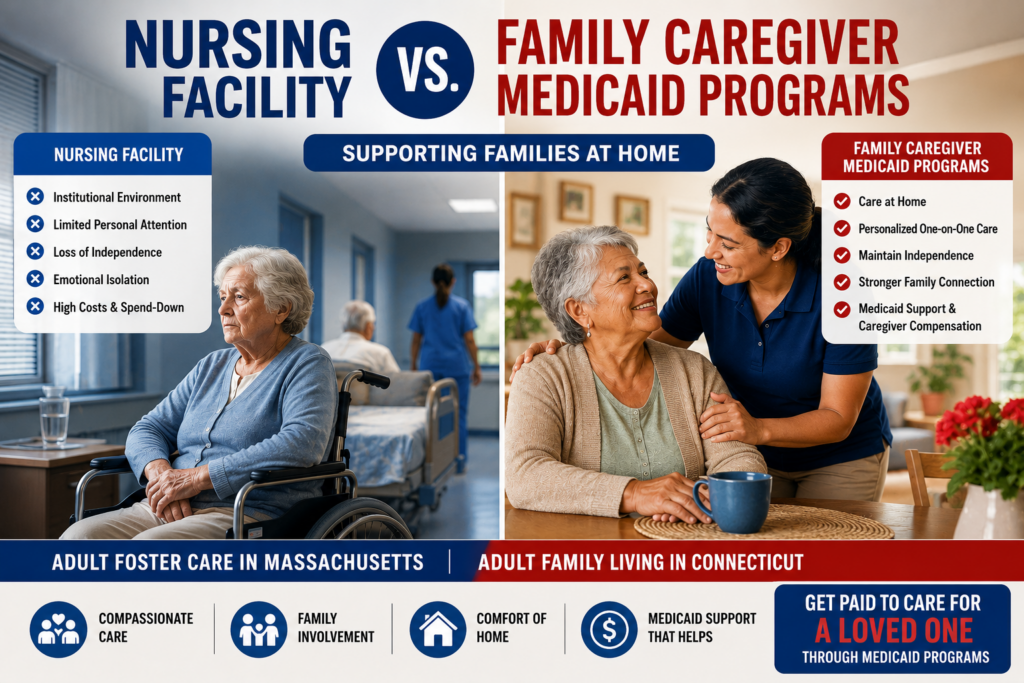
Why More Families Are Choosing Adult Foster Care (AFC) and Adult Family Living (AFL) Instead of Nursing Facilities
For many families in Massachusetts and Connecticut, one difficult question eventually arises:
Should your loved one move into a nursing facility — or remain safely at home with support through a Medicaid caregiver program?
Today, more families are choosing home-based Medicaid programs such as:
These programs allow seniors and adults with disabilities to receive daily care from someone they already know and trust — often a family member or close friend — while remaining in the comfort of home.
At the same time, concerns surrounding nursing facilities continue to push families toward caregiver-based alternatives. Emotional isolation, staffing shortages, loss of independence, and the emotional decline many families witness after placement are leading more people to explore home care options.
This article explains:
- The major challenges families face with nursing facilities
- Why AFC and AFL programs are growing rapidly
- How Medicaid supports home-based caregiving
- Why home care is often the preferred long-term care solution for seniors and disabled adults
The Growing Concern Around Nursing Facilities
Nursing facilities continue to play an important role for individuals who require intensive medical supervision. However, many families are actively searching for alternatives because of the emotional and practical challenges associated with institutional care.
Across Massachusetts and Connecticut, Medicaid programs are increasingly prioritizing home and community-based care because research consistently shows that many individuals experience better emotional outcomes and improved quality of life when they remain at home. (Massachusetts Government)
Major Challenges Families Face With Nursing Facilities
1. Emotional Decline and Isolation
One of the biggest concerns families report after nursing home placement is emotional decline.
Seniors who leave their homes often experience:
- Loneliness
- Depression
- Anxiety
- Social withdrawal
- Loss of motivation
The transition from a familiar home environment into an institutional setting can be emotionally overwhelming, especially for individuals with dementia, Alzheimer’s disease, or mobility limitations.
Many families notice that their loved one becomes less socially engaged after entering a nursing facility. The loss of familiar routines, neighbors, pets, and family interaction can significantly affect emotional well-being.
In online caregiver communities, Connecticut families frequently express fear that loved ones may decline more rapidly after placement into nursing homes. (Reddit)
2. Loss of Independence
Nursing facilities operate on schedules designed for large groups of residents.
This often means residents must adjust to:
- Set meal times
- Shared living environments
- Structured routines
- Less privacy
- Reduced personal freedom
For seniors who have lived independently for decades, losing control over their daily life can be emotionally difficult.
By comparison, home-based caregiver programs allow individuals to:
- Stay in familiar surroundings
- Maintain personal routines
- Continue participating in family life
- Preserve a stronger sense of independence
3. Staffing Shortages and Limited Personalized Attention
Families often worry about whether nursing facility staff can provide enough individualized attention.
Common concerns include:
- Delayed response times
- Overworked caregivers
- Inconsistent staffing
- Limited one-on-one care
- High staff turnover
Even in high-quality facilities, staff members are frequently responsible for multiple residents simultaneously. This can make personalized care more difficult compared to a home setting where care is centered around one individual.
This concern is one major reason many families are now exploring Medicaid caregiver programs instead of institutional placement.
4. Financial Pressure and Medicaid Spend-Down Rules
Nursing home care is extremely expensive.
Families pursuing Medicaid nursing facility coverage often face:
- Strict income limits
- Asset spend-down requirements
- Financial stress
- Complex Medicaid planning
Massachusetts Medicaid discussions frequently highlight how nursing home applicants must spend down assets and contribute most of their monthly income toward facility costs. (Reddit)
For many families, this creates fear about:
- Losing savings
- Losing property
- Long-term financial instability
5. Reduced Family Connection
In nursing facilities, family members often transition from caregivers into visitors.
This emotional shift can be difficult for both the loved one and the family.
Many seniors thrive emotionally when cared for by someone they already know and trust. Familiar caregivers can provide:
- Emotional comfort
- Consistency
- Better communication
- Personalized support
- Stronger companionship
This is one reason Medicaid programs such as Adult Foster Care and Adult Family Living continue expanding across both states.
Adult Foster Care (AFC) in Massachusetts
The Massachusetts Adult Foster Care (AFC) Program is a MassHealth-funded caregiver program designed to help eligible individuals remain safely at home instead of entering a nursing facility. (Massachusetts Government)
Under the AFC program:
- A caregiver lives with the member
- Care is provided in a private home setting
- The caregiver may be a family member or trusted friend
- The caregiver receives financial compensation and professional support
The program is intended for individuals who need help with Activities of Daily Living (ADLs), including:
- Bathing
- Dressing
- Mobility
- Eating
- Toileting
- Medication reminders
- Daily supervision
MassHealth states that AFC helps individuals maintain independence while receiving care in a home environment. (Massachusetts Government)
Why Massachusetts Families Prefer AFC Over Nursing Homes
Familiar Environment
Remaining at home often creates greater emotional stability for seniors and adults with disabilities.
Instead of adapting to an unfamiliar institution, individuals remain surrounded by:
- Family
- Familiar routines
- Personal belongings
- Community connections
Personalized One-on-One Care
Unlike institutional settings where staff care for multiple residents, AFC care is highly individualized.
Caregivers know:
- The person’s habits
- Their emotional needs
- Their routines
- Their medical history
- Their preferences
This often leads to stronger emotional support and improved quality of life.
Financial Support for Caregivers
AFC programs recognize that caregiving requires time, energy, and commitment.
The program provides compensation and care management support, helping families continue caregiving without facing the full financial burden alone. (Mass Care Link)
Adult Family Living (AFL) in Connecticut
Connecticut’s Adult Family Living (AFL) Program is a Medicaid-funded home care option that allows seniors and disabled adults to receive care from a live-in caregiver instead of moving into a nursing facility. (MyPlaceCT)
The caregiver is often:
- A family member
- A close friend
- Someone already trusted by the individual
The caregiver either:
- Moves into the participant’s home
OR - The participant moves into the caregiver’s home
The AFL program is commonly connected to:
- Connecticut Home Care Program for Elders (CHCPE)
- Personal Care Assistance (PCA) Waiver programs (MyPlaceCT)
Why Connecticut Families Are Choosing AFL
Families Want Loved Ones at Home
Many Connecticut families want to avoid nursing home placement whenever safely possible.
The AFL program helps make this possible by providing:
- Financial caregiver support
- Oversight and case management
- Medicaid-funded services
- Long-term home care stability
Better Emotional Well-Being
Home-based care can significantly improve emotional comfort because the individual remains:
- In familiar surroundings
- Close to loved ones
- Connected to their community
For seniors with dementia or cognitive decline, familiar environments can reduce confusion and emotional distress.
Greater Trust and Comfort
Many families feel more comfortable knowing care is provided by someone the individual already knows.
This creates:
- Stronger emotional security
- Better communication
- Greater trust
- More consistent daily support
Why Medicaid Is Expanding Home-Based Care Programs
Both Massachusetts and Connecticut continue investing in home and community-based care because:
- It is often less expensive than institutional care
- Families strongly prefer it
- It promotes independence
- It improves quality of life for many individuals
Programs like AFC and AFL reflect a major shift in long-term care:
keeping people safely at home whenever possible instead of placing them into institutions.
Even public discussions around Medicaid policy increasingly emphasize protecting access to home care services because families depend on them to avoid nursing home placement. (Reddit)
Nursing Facilities vs. AFC & AFL Programs
| Nursing Facilities | AFC & AFL Home Care Programs |
|---|---|
| Institutional environment | Home-based environment |
| Limited individualized attention | Personalized one-on-one care |
| Residents follow facility schedules | Flexible family-centered routines |
| Emotional isolation can occur | Stronger emotional connection |
| Family becomes visitors | Family remains actively involved |
| Higher institutional costs | Medicaid-supported home care |
| Unfamiliar caregivers | Trusted caregiver relationships |
| Reduced independence | Greater dignity and independence |
Final Thoughts
For many families in Massachusetts and Connecticut, the goal is no longer simply finding care — it is finding the right environment for long-term well-being.
While nursing facilities remain necessary for some individuals with complex medical needs, many seniors and adults with disabilities can safely remain at home through:
These programs provide families with an alternative that prioritizes:
- Dignity
- Independence
- Emotional well-being
- Family connection
- Personalized support
More families today are realizing that quality care does not always require institutional placement. In many cases, the best care happens in the place people feel safest and most comfortable — home.