
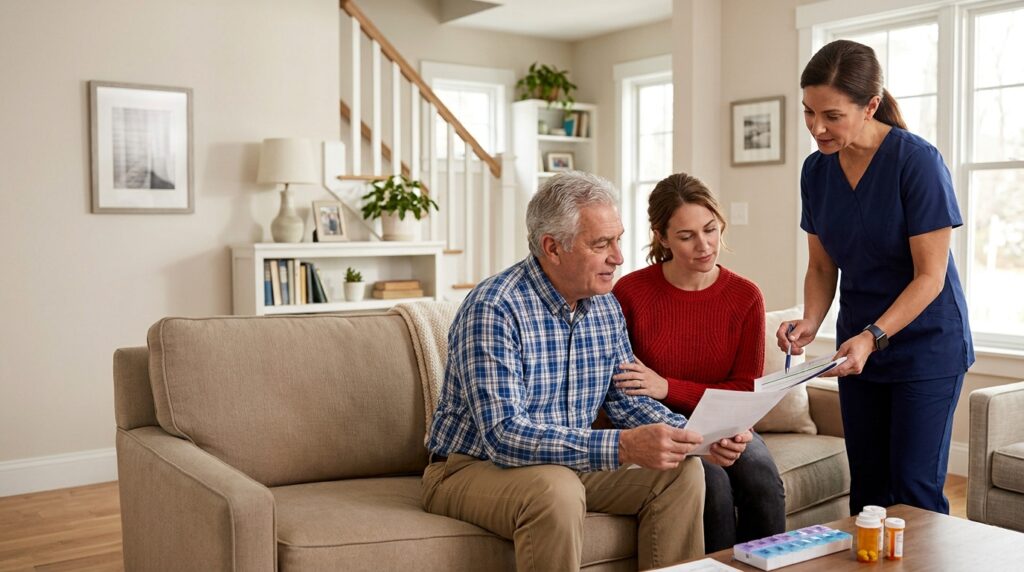
What to Do After a Hospital Stay: A Family Caregiver’s Guide to Safely Bringing a Loved One Home
Coming home from the hospital is often a welcome moment for a patient and their family. But the transition from hospital to home can also be challenging.
A loved one may still be weak, recovering from surgery, adjusting to new medications, dealing with a chronic condition, or struggling with everyday activities that were once easy.
For family caregivers, the days immediately following discharge can raise important questions:
Who will help with medications?
Can my loved one safely walk to the bathroom?
Who will help with bathing and dressing?
Does my loved one need a nurse at home?
Could MassHealth help pay for personal care services?
Would PCA or Group Adult Foster Care be appropriate?
The right answer depends on the individual’s medical condition, functional needs, insurance coverage, and care plan.
In Massachusetts, programs such as Skilled Nursing Services, Group Adult Foster Care (GAFC), and the Personal Care Attendant (PCA) Program can provide different types of support for eligible individuals living at home or in qualifying community settings. MassHealth lists these among its in-home and long-term services and supports.
This guide explains what families should consider after a hospital stay and how different home-based services may fit into a safe transition home.
Why the Transition From Hospital to Home Matters
A hospital discharge does not necessarily mean that a person has returned to their previous level of health or independence.
Someone may be medically stable enough to leave the hospital but still require help with:
- Walking and transferring
- Bathing and dressing
- Preparing meals
- Managing medications
- Monitoring a chronic condition
- Wound care
- Following post-discharge instructions
- Attending follow-up appointments
- Managing new equipment or medical treatments
- Recognizing warning signs that require medical attention
This is why discharge planning should not end when the patient walks out of the hospital.
A successful transition considers what the person needs at home—not simply whether they are ready to leave the hospital.
1. Start With the Hospital Discharge Plan
Before bringing your loved one home, carefully review the discharge instructions.
Ask the hospital team:
- What diagnosis or condition is being treated?
- What medications have changed?
- When should medications be taken?
- Are there new restrictions on activity?
- Does the patient need assistance with walking or transfers?
- Are there wound-care instructions?
- Are follow-up appointments scheduled?
- Does the patient need physical, occupational, or speech therapy?
- Does the patient need nursing care at home?
- What symptoms should prompt a call to the doctor?
- Who should the family contact if problems arise?
Do not be afraid to ask the hospital team to explain something again.
A clear understanding of the discharge plan is one of the first steps toward a safer recovery at home.
2. Review Your Loved One’s Medication List
Medication changes are common after hospitalization.
Your loved one may come home taking:
- New medications
- Different doses
- Temporary medications
- Antibiotics
- Pain medications
- Blood thinners
- Diabetes medications
- Medications for blood pressure or heart conditions
Create one current medication list and compare it with the instructions provided at discharge.
If something is unclear, contact the appropriate healthcare professional rather than guessing.
Medication management can become especially complicated when an older adult takes multiple prescriptions or has cognitive or memory challenges.
Depending on the individual’s needs and authorization, skilled nursing services may provide professional support with medication-related care and monitoring, while personal care programs may provide different types of non-medical assistance.
A Better Life Homecare provides Massachusetts Skilled Nursing Services that may include medication management, disease-process education, wound care, in-home blood draws, IV therapy, and other skilled services based on the individual’s care needs.
3. Make the Home Safe Before Your Loved One Arrives
A home that was perfectly safe before hospitalization may become more difficult to navigate during recovery.
Look for potential hazards such as:
- Loose rugs
- Cluttered walkways
- Poor lighting
- Electrical cords across walking areas
- Slippery bathroom surfaces
- Low furniture
- Difficult-to-reach items
- Stairs without adequate support
- Frequently used items stored too high or too low
Consider keeping essential items within easy reach.
If your loved one is weak or unsteady, ask their healthcare team whether they need a mobility assessment or assistive equipment.
The goal is not to make the person dependent.
The goal is to make the home safer while supporting as much independence as possible.
4. Determine What Kind of Help Your Loved One Actually Needs
One of the biggest mistakes families make after a hospitalization is assuming that every type of home care provides the same services.
It doesn’t.
A person recovering from surgery may need skilled clinical care.
Another person may be medically stable but need assistance with bathing, dressing, toileting, mobility, or meal preparation.
Someone else may need ongoing personal care and care coordination while living in an approved community setting.
This is where understanding the difference between Skilled Nursing, GAFC, and PCA services becomes important.
5. When Skilled Nursing Services May Be Appropriate
Skilled Nursing Services are designed for individuals who require professional healthcare services that must be provided or overseen by qualified clinicians.
After a hospitalization, skilled nursing may be appropriate when a person has ongoing medical needs such as:
- Wound care
- Medication-related clinical management
- Disease monitoring
- IV therapy
- Blood draws
- Post-hospital medical monitoring
- Patient and caregiver education
- Other physician-ordered skilled services
MassHealth’s home health guidance explains that home health services can include intermittent skilled nursing visits and that medical necessity and authorization requirements may apply.
A Better Life Homecare provides skilled nursing support in Massachusetts as part of its home health services. The agency describes services including medication management, wound care, disease-process education, Coumadin management, in-home blood draws, and IV therapy.
When should a family ask about skilled nursing?
Consider speaking with the healthcare team about skilled nursing if your loved one:
- Has a complex medical condition
- Needs professional wound care
- Has recently undergone surgery
- Requires clinical monitoring
- Has significant medication-management needs
- Requires IV therapy
- Needs education related to a new diagnosis or treatment
The exact services and coverage depend on medical necessity, the individual’s MassHealth or other insurance coverage, authorization requirements, and the applicable program.
6. When Personal Care May Be More Important Than Skilled Nursing
Not every person who needs help at home needs a nurse.
Sometimes the biggest challenge after hospitalization is simply getting through the day safely.
Your loved one may need help with:
- Bathing
- Dressing
- Grooming
- Toileting
- Eating
- Mobility
- Transfers
- Meal preparation
- Shopping
- Laundry
- Light housekeeping
- Transportation coordination
These are different from skilled medical services.
For eligible MassHealth members, the Personal Care Attendant (PCA) Program can provide support with activities of daily living while helping people remain in their homes and communities. MassHealth describes PCA as a self-directed program in which the consumer-employer recruits, hires, trains, schedules, and manages the PCA.
7. Understanding PCA Services in Massachusetts
The Massachusetts PCA Program is particularly relevant for individuals who need ongoing physical assistance with daily activities because of a permanent or chronic disability.
According to MassHealth’s current program information, eligibility generally includes:
- MassHealth Standard or CommonHealth eligibility
- A permanent or chronic disability
- A need for physical assistance with two or more Activities of Daily Living (ADLs)
- The ability to manage PCA services directly or through a surrogate or administrative proxy
PCA services may include assistance with:
- Personal hygiene
- Bathing
- Dressing
- Eating
- Mobility and transfers
- Meal preparation
- Shopping
- Light housekeeping
- Transportation to medical appointments
- Other approved personal-care activities
One important difference is that the PCA consumer is the employer of the PCA. This means the consumer, or an appropriate surrogate/proxy, has significant responsibility for managing the worker.
A Better Life Homecare also provides PCA-related support and case management in Massachusetts, including assistance with ADLs and IADLs, medication reminders/cueing, wellness nursing visits, and skilled nursing referrals.
Could PCA be useful after a hospital stay?
Potentially—but eligibility is not based simply on having been hospitalized.
PCA is generally intended for people who meet MassHealth’s disability and functional requirements. A hospital stay alone does not automatically make someone eligible.
That distinction is important for families planning post-hospital care.
8. Understanding Group Adult Foster Care (GAFC)
Another option Massachusetts families may want to explore is Group Adult Foster Care (GAFC).
MassHealth’s current GAFC fact sheet states that the program provides personal care services to eligible individuals living in a home setting. Direct care workers employed by a GAFC agency provide the personal care, while nursing and case-management oversight support the care plan.
GAFC eligibility generally includes individuals who:
- Are 22 or older
- Qualify for MassHealth Standard or CommonHealth
- Need physical assistance or cueing and supervision with at least one Activity of Daily Living
GAFC can include:
- Assistance with activities of daily living
- Cueing and supervision
- Medication reminders
- Nursing oversight
- Case management
- Personalized care planning
- Daily assistance from a direct-care worker
GAFC and recovery after hospitalization
GAFC may be worth discussing when an individual is medically stable but needs ongoing personal-care assistance and structured oversight.
For example, an older adult may return home after hospitalization but still need help with:
- Bathing
- Dressing
- Mobility
- Personal hygiene
- Daily routines
- Medication reminders
- Maintaining safety
GAFC is different from skilled nursing because its primary focus is personal care and community-based support, rather than replacing medically necessary skilled nursing.
9. Skilled Nursing vs. PCA vs. GAFC: What’s the Difference?
Understanding the difference can make conversations with healthcare professionals and care coordinators much easier.
| Program/Service | Primary Purpose | Examples of Support |
|---|---|---|
| Skilled Nursing | Professional medical care at home | Wound care, medication management, IV therapy, disease monitoring, clinical education |
| PCA | Self-directed personal care | Bathing, dressing, mobility, eating, toileting, meal preparation, approved household tasks |
| GAFC | Personal care with agency oversight | ADL assistance, cueing/supervision, medication reminders, nursing oversight, case management |
These services have different eligibility requirements and administrative structures. MassHealth identifies all three among its home and community-based services, but they are designed for different needs.
The right question isn’t “Which program is best?”
It’s:
“What level and type of care does my loved one need right now?”
10. Some Families May Need More Than One Type of Support
Care needs are not always one-dimensional.
A person could need skilled medical care while also needing help with everyday activities.
For example, imagine an older adult who returns home after surgery.
They may need:
Skilled Nursing
- Wound monitoring
- Medication-related clinical care
- Health assessment
Personal Care
- Bathing
- Dressing
- Mobility assistance
Family Support
- Transportation
- Meals
- Emotional support
- Help attending appointments
In situations like this, families should work with healthcare providers and appropriate care coordinators to determine which services are medically necessary and which programs the individual may qualify for.
A Better Life Homecare’s Massachusetts services include Skilled Nursing, GAFC, PCA, and Adult Foster Care, giving families multiple avenues to explore depending on the individual’s circumstances.
11. Watch for Warning Signs During the First Few Days at Home
The first several days after discharge can reveal problems that were not obvious in the hospital.
Family caregivers should pay attention to changes such as:
- Increasing weakness
- Difficulty walking
- Confusion or unusual behavior
- Difficulty taking medications correctly
- Poor appetite or difficulty eating
- Problems managing personal hygiene
- Falls or near-falls
- Worsening pain
- Difficulty following discharge instructions
- Signs of infection
- Difficulty managing medical equipment
- Missed appointments or medications
If you notice a significant change in your loved one’s condition, contact their healthcare provider or seek urgent medical attention when appropriate.
Do not wait for a crisis to ask whether additional support is needed.
12. Create a Simple Family Caregiving Plan
A written plan can reduce stress and prevent family members from assuming someone else is handling an important task.
Consider creating a simple schedule covering:
Morning
- Medication routine
- Breakfast
- Personal hygiene
- Mobility
- Wound care if prescribed
Afternoon
- Meals
- Rest
- Exercise or therapy as recommended
- Appointments
- Personal care
Evening
- Medication
- Dinner
- Personal hygiene
- Safety check
- Preparing for bedtime
Also write down:
- Doctor’s phone number
- Pharmacy information
- Emergency contacts
- Medication list
- Follow-up appointments
- Insurance/MassHealth information
- Caregiver responsibilities
Organization can make the transition home much more manageable.
13. Don’t Wait Until the Family Caregiver Is Overwhelmed
Family caregivers often try to do everything themselves.
That may work temporarily—but it can become unsustainable.
If caregiving begins affecting your:
- Work
- Sleep
- Physical health
- Relationships
- Finances
- Emotional well-being
…it may be time to explore additional support.
Asking for help is not a failure to care.
In many cases, getting appropriate support allows family members to spend more meaningful time with their loved ones instead of spending every hour managing care tasks.
How A Better Life Homecare Can Help Massachusetts Families
A Better Life Homecare is committed to “Supporting Families at Home.”
The agency provides several Massachusetts programs and services designed to help eligible individuals receive appropriate care while remaining connected to their homes and communities.
Depending on individual needs and eligibility, families can explore:
Skilled Nursing Services
For eligible individuals who require professional nursing and clinical support at home.
Learn more:
Skilled Nursing Services at A Better Life Homecare
Group Adult Foster Care (GAFC)
For eligible MassHealth members who need personal care support, cueing/supervision, and ongoing nursing and case-management oversight.
Learn more:
A Better Life Homecare Massachusetts Services
Personal Care Attendant (PCA) Services
For eligible MassHealth members who meet the program’s disability and functional requirements and need physical assistance with activities of daily living.
Learn more:
PCA Services in Massachusetts
Adult Foster Care (AFC)
For eligible individuals who need daily personal-care assistance and can safely live with a qualified caregiver in a shared-home arrangement.
Learn more:
Adult Foster Care Program in Massachusetts
Frequently Asked Questions About Care After a Hospital Stay
How long does it take to recover after a hospital stay?
Recovery varies significantly depending on the person’s diagnosis, age, medical history, surgery or illness, and level of independence before hospitalization.
Some people return to their normal routine quickly, while others need weeks or months of additional support.
Does MassHealth cover home care after a hospital stay?
MassHealth offers multiple home and community-based services, including skilled nursing, PCA, GAFC, and other long-term services and supports. Eligibility, medical necessity, authorization, and program requirements vary.
Does a hospital discharge automatically qualify someone for skilled nursing?
No. A hospital stay by itself does not automatically establish eligibility for skilled nursing. Home health services are subject to medical necessity and applicable authorization and coverage requirements.
What is the difference between home care and skilled nursing?
Home care can refer broadly to assistance with everyday activities and personal care, while skilled nursing involves professional healthcare services that require qualified clinical personnel.
The two types of support can sometimes complement one another.
Can PCA services help after hospitalization?
They may, if the individual meets MassHealth PCA eligibility requirements. The PCA Program is designed for eligible people with permanent or chronic disabilities who require physical assistance with two or more ADLs.
A temporary recovery period alone does not necessarily qualify someone for PCA.
What is GAFC in Massachusetts?
Group Adult Foster Care is a MassHealth program providing personal care services to eligible adults who live in a home setting. Current MassHealth guidance identifies eligibility for adults 22 or older who need physical assistance or cueing and supervision with at least one ADL and qualify for MassHealth Standard or CommonHealth.
Final Thoughts: The Goal Is a Safe Transition Home
Coming home from the hospital should be more than simply leaving the hospital building.
It should mean having a realistic plan for what happens next.
For some people, that may mean a short period of skilled nursing.
For others, it may mean personal care assistance through PCA or GAFC.
For many families, it may involve a combination of professional services and family support.
The most important step is to evaluate your loved one’s medical needs, daily living needs, safety, and ability to remain independent at home.
If your family is navigating a hospital discharge in Massachusetts, A Better Life Homecare can help you understand the home-based care options that may be available and determine what type of support may be appropriate.
Your loved one deserves a safe transition home—and your family deserves support along the way.
A Better Life Homecare Massachusetts: Supporting Families at Home
If you are caring for a loved one after hospitalization and are unsure what type of support may be appropriate, contact A Better Life Homecare to discuss your options.